
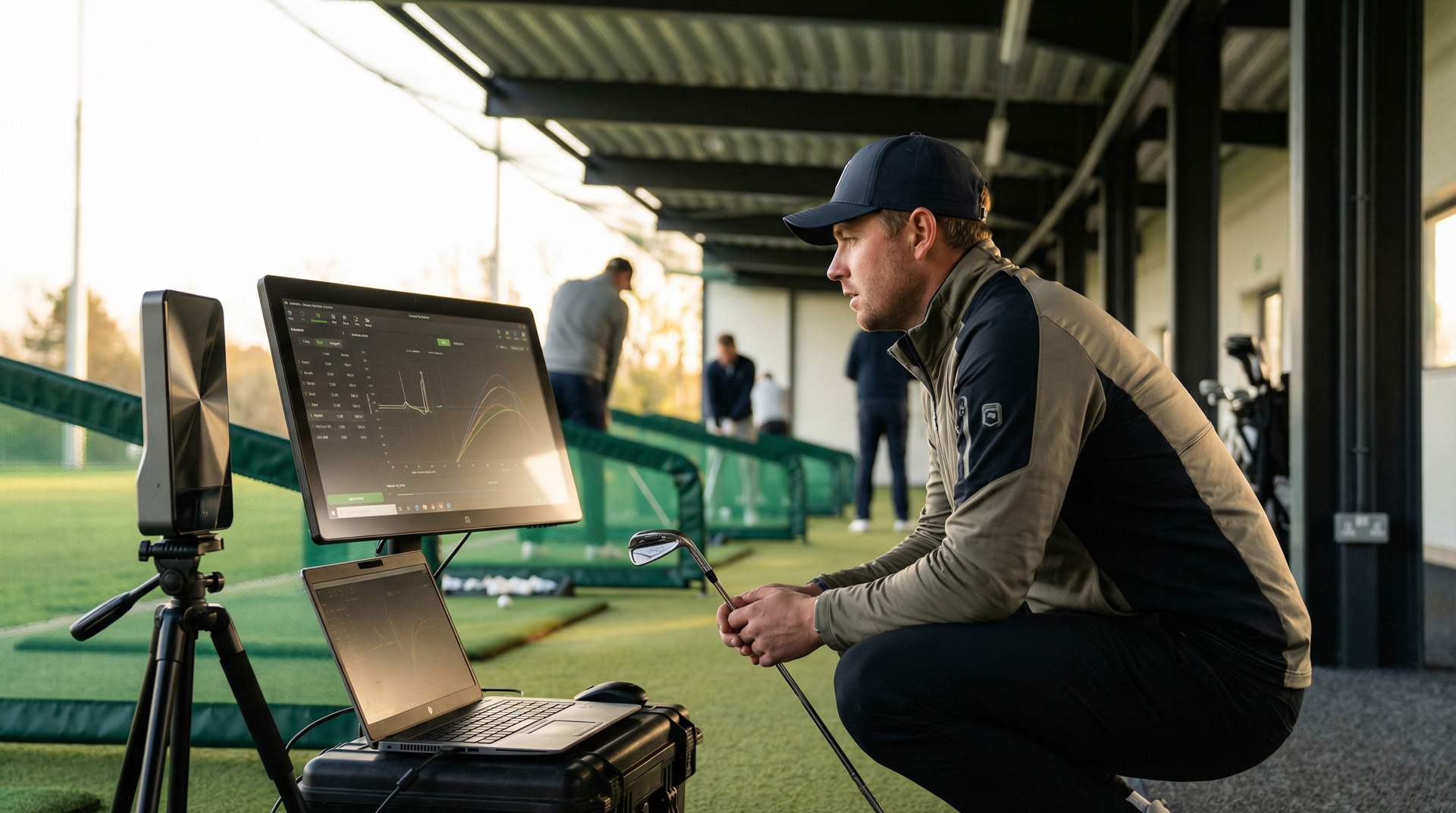
The pursuit of maximum driver distance is often misguided. Golfers fixate on clubhead speed as the sole variable for yards gained, neglecting the critical physics of impact. The result is a cycle of inefficient strikes, excessive spin, and suboptimal ball flight. This leads to the fundamental question we receive from data-conscious players: “What is the optimal launch and spin for my driver, and how do I achieve it?”
Answering this requires moving beyond anecdotal advice and into the realm of verifiable data. The objective is not simply to hit the ball harder, but to convert clubhead speed into ball speed and carry distance with maximum efficiency. This analysis will deconstruct the key metrics that define an optimal launch and spin driver performance, providing a clear, physics-based protocol for improvement.
The Core Physics of Distance
Total distance is a function of three primary ball flight parameters: Ball Speed, Launch Angle, and Spin Rate. Ball speed is the most significant contributor, determined by the clubhead speed and the quality of impact (Smash Factor). However, for any given ball speed, the combination of launch angle and spin rate dictates the ball’s trajectory, hang time, and subsequent carry distance. An inefficient combination will rob a player of significant yardage, even with elite clubhead speed.
Driver Attack Angle
The Attack Angle (AoA) is the vertical direction the clubhead is moving at the point of maximum compression. It is measured in degrees, with a positive value indicating an upward strike and a negative value indicating a downward strike. For the driver, a positive (upward) AoA is a prerequisite for efficient distance. Striking up on the ball promotes a higher launch angle while simultaneously reducing backspin. This is the mechanical foundation of the modern “high launch, low spin” paradigm. A negative AoA necessitates adding loft to get the ball airborne, which in turn increases spin loft and creates a less efficient, shorter ball flight.
Dynamic Loft vs Static Loft
Static loft is the number stamped on the clubhead (e.g., 9.0°, 10.5°). Dynamic loft is the actual loft presented to the golf ball at the moment of impact. It is a product of the club’s static loft, the golfer’s attack angle, the forward shaft lean, and how the club is released. Two players using a 9.0° driver can present vastly different dynamic lofts. A player with a +5° AoA may present a 14° dynamic loft, while a player with a -5° AoA may only present a 10° dynamic loft. Understanding this distinction is critical; you must optimize the loft you deliver, not just the loft you buy.
Spin Loft Explained
Spin Loft is the three-dimensional angle between the dynamic loft and the attack angle. It is the single largest determinant of a golf ball’s spin rate. A higher spin loft creates more backspin. A lower spin loft creates less backspin. For a driver, the goal is to generate a high launch with the lowest possible spin loft. A positive attack angle is the most effective way to achieve this. By striking up on the ball (+AoA), you can present a high dynamic loft for launch while keeping the delta between it and the AoA small, thus minimizing spin.
A Data-Driven Optimization Protocol
Achieving your optimal ball flight is a systematic process of measurement, diagnosis, and adjustment. It requires access to reliable launch monitor data to make informed decisions instead of relying on guesswork.
Increase Driver Distance Through Data Analysis
The first step is to establish a baseline. Capture data for 10 well-struck drives on a reputable launch monitor like a Trackman or Foresight GCQuad. You must know your current ball speed, launch angle, spin rate, and attack angle. For most amateur golfers with clubhead speeds between 95-105 MPH, an optimal launch window is typically 12-15 degrees with a spin rate between 2000-2500 RPM. If your spin is significantly higher (e.g., >3000 RPM) and your launch is low, your attack angle is the primary suspect. You can influence AoA by adjusting ball position further forward in the stance and increasing the amount of spine tilt away from the target at address. These adjustments promote an ascending arc into the ball.
Gear Effect on Driver
Strike location is a powerful variable. The curvature of a modern driver face, known as bulge and roll, creates the “gear effect.” A strike high on the face will produce a higher launch angle and a lower spin rate than a centered strike. Conversely, a strike low on the face will launch lower and spin more. This vertical gear effect can be used to your advantage. Once you have a neutral or positive attack angle, learning to consistently strike the ball slightly above the geometric center of the face is a proven method for reducing spin without sacrificing launch angle. This is often more effective than simply purchasing a lower-lofted driver.
Trackman Driver Data: An Illustrative Comparison
Consider two golfers with identical 105 MPH clubhead speeds and a 9.0° driver. Golfer A has a -4° attack angle. Their dynamic loft is 11°, resulting in a high spin loft of 15°. This delivery produces a launch angle of 10° and a spin rate of 3400 RPM, leading to a carry distance of 245 yards. Golfer B trains to achieve a +4° attack angle. Their dynamic loft is 15°, but their spin loft is only 11°. This delivery produces a launch angle of 14° and a spin rate of 2200 RPM, resulting in a carry distance of 270 yards. The 25-yard gain is not from swinging harder, but from a radical improvement in impact efficiency.
Conclusion
Maximizing your driving distance is an engineering problem. The solution lies in optimizing the relationship between your delivered attack angle, dynamic loft, and spin loft. Stop chasing speed blindly. Instead, use launch monitor data to diagnose your impact conditions. By focusing on achieving a positive attack angle and controlling strike location, you can unlock a more efficient transfer of energy, reduce performance-robbing spin, and achieve a measurably longer and more effective ball flight.